_edited.jpg)
Moscow Murder

Updated: Jul 21
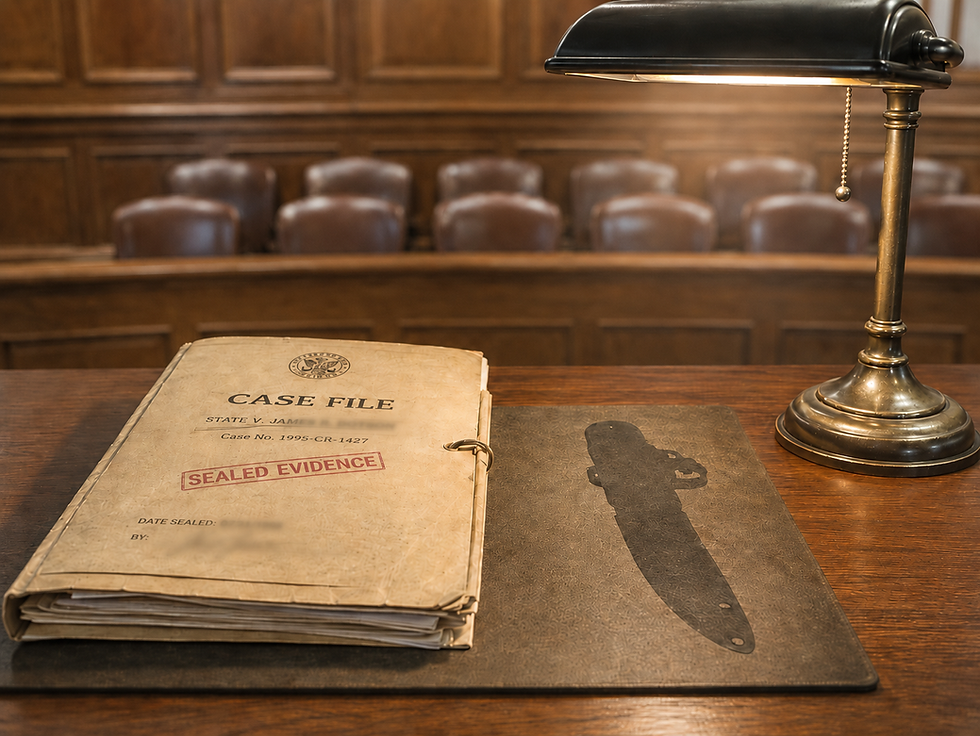
In the wee hours of November 13, 2022 in Moscow Idaho, four University of Idaho students were bludgeoned to death. First responders claimed the aftermath was remnant of a frenzied rage.
A weeping student living in the small house just off campus, who hid during the attack, called 911, eight hours after the alleged time of the murders. Fear drove her to wait so long, she said.
After a walk-through of the murder scenes at 1122 King Road, a stone-faced, hazmat-suited forensic investigator exited saying, I’ve never seen anything so horrific. It was a bloody massacre. There were no less than 80 stab wounds found on the victims; one was nearly decapitated.
The suspected murder weapon: A large hunting knife.
Dead were a twenty-year-old male and a female, boyfriend and girlfriend, and two 21 year-old females. The women were residents of the house, sorority girls, living off campus. The male was a member of the nearby Sigma Chi fraternity, who often stayed at the King Road address.
Pictures from outside of the small house, once owned by the college president’s family, showed what appeared to be blood seeping through the frame and floorboards.
Police tracked the outside of the house for clues. Despite the apparent blood seeping from the inside of the house, there were surprisingly limited blood traces on the outside of the house.
A whodunit search immediately began calling-in state and federal lawmen. The Moscow police chief, whose officers were also charged with college security, seesawed from maintaining the victims were “targeted,” to “ we don't know whether the murderer or murderers knew the victims.” The college was closed down until December, after the Thanksgiving holiday.
Authorities appeared clueless for weeks, but then on December 30th, 2022 a cabal of law enforcement officers tracked a 28 year-old Ph.D student, Bryan Kohberger to his parents home in Pennsylvania where he was visiting for the holidays. He was a doctoral student at Washington State, just across the state line from the University of Idaho.
In the early morning hours, the police stormed-trooped his parents’ house and arrested Kohberger for the four murders. Within days he waived extradition to Idaho, saying he’d be exonerated of the crimes.
Jailed in Latah County in Moscow, Kohberger was held without bond. A public defender, Ann Taylor was appointed for his defense.
Evidence
In a Probable Cause affidavit, law enforcement claimed Kohberger’s DNA, (trace residue) was found on a button snap of a knife sheath located at the scene.
Also, in-evidence was the matter ofKohberger’s white Elantra, similar in make and model to a car seen the morning of the murder. He was never identified as a driver in a suspect vehicle.
Connecting Kohberger to the crimes was a statement from one of two young women who were living at the house on King Road and supposedly in-hiding there when the killings happened.
The 20 year old said she saw a man in the house at the time of the murders who was wearing a mask and had heavy eyebrows, eyebrows similar to Kohberger’s, according to a police connection.
But the young woman didn’t comment whether she heard horrific screams from her roommates being bludgeoned to death. And the police didn’t press her about her statement, or question the other roommate about the delay waiting for over 8 hours to call the police.
Other damning evidence against Kohberger pointed to his cell phone, which was turned off during the times of murders, approximately 4 am. Despite being muted or turned off, his cell location was tracked to being nearby the King Road house the morning of the 13th. Kohberger said he’d been out for a late night drive as a reason for not being home at his apartment across state line Washington when the murders occurred.
In the first weeks of the investigations the house at King Road was demolished, ordered by the Judge. “It was too much of a reminder,” the University president claimed. There was no opposition from the Defense, despite the demolition destroying the crime scene.
His character
Within days of labeling him as the lone perpetrator, the legacy media got on the band wagon of “he did it.” From high and low broadcast voice boxes, premadonnas emphatically accused the graduate student of being awkward and having the same MO as an incel; a subculture of heterosexual men wanting romance, but who are incapable of having it. This diagnosis, TV psychologists claimed, led to Kohberger’s madness, triggering him to attack the women at the King Road house.
Aspersions and attacks continued on Kohberger’s character. His past heroin addiction, mental health pontificators said, played into his murderous way, as well as his general oddness. His diagnosis of autism somehow was factored into the crimes, as was having OCD characteristics.
One professional mental health person harangued on a popular cable talk show, “You can see it in his eyes.” Other portrayals of him were sent across the airwaves depicting a man, who just looked the part of a serial killer.
Seen as a man getting a high-brow degree, some said, he had a reputation of being rude toward female students, grading them unfairly in his capacity as a teaching assistant. Legacy media and most traditional cable venues smiled and nodded about the castigations against Kohberger.
Receipts
As evidence was stacked against Kohberger, police also found a receipt that showed he purchased a mask on Amazon similar to the one seen by the student who said she saw a masked man in the house that November morning.
Investigation into Kohberger's buying history led to finding some reference to him buying a KBar knife before the murder, the suspected murder tool, a conclusion consistent with the knife sheath that was found.
The short of it was “we got our man,” according to crime bookwriters capitalizing on the event, along with well-known media celebrities.
Stacked against him
The death penalty by firing squad was sought after a first judge allowed a prosecutor-lead closed grand jury to indict Kohberger, pre-empting an open-court preliminary probable cause hearing.
As procedural hearings unfolded over the months, the public defender, an Idaho law school graduate, continually motioned the judge to get discovery from the prosecution, also an Idaho law school graduate. She said time-rule procedures had been violated. Without discovery, the Defense couldn’t competently provide what was needed in this capital case. These petitions for timely discovery were not prudently addressed by the Judge. When the case was moved in a change-of-venue to Boise, the Defense continued with these motions.
The Defense was on record in court proclaiming that Kohberger was not guilty, saying there were alternative theories of ‘who done it’.
As the weeks closed in on a trial date, the PD maintained they were not ready for a trial.
The second judge’s aloof, dismissive manner toward the defense and his denial to admit the testimony of an expert witness, saying that witness was a conspiracy theorist, was the last straw for the PD Taylor. In late Spring of 2025, in a surprise move, Kohberger pleaded guilty.
In June of 2025, two-and-one half years after the murders Kohberger was given four life sentences, a trade-off to avoid the firing squad.
While Kohberger pleaded to the crimes, he never confessed to the murders, or related why he committed them, or where the murder weapon was, or what connection he had to the victims to begin with. In fact, while allocution, the process done in sentencing allowing a defendant to disclose their part in the crime, Kohberger said nothing.
Prosecutors openly said after sentencing they could find no link Kohberger had to the victims. They also disclosed that despite the bloody scene at the King Road house, no other DNA of Kohbergers, other than the knife sheath had ever been found at the crime scene. And no trace of blood or body fragments from the victims had been found in Kohberger's car or at his apartment.
When prosecutors were asked by the press, those who still had an inkling of curiosity about the strength of the case, if they’d ever inquired from Kohberger about the specifics of the crimes, they answered they had not. Prosecutors said if Kohberger were asked, he’d likely lie to them anyway.
With legacy media largely dismissing any contrary findings suggesting Kohberger was framed for these crimes, each week files once closed were opened for public viewing. With these releases more and more suspicions arose.
Although the police and prosecutors have wiped their hands of this crime, Kohberger could petition for a Post Conviction Relief (PCR) This procedure allows for a challenge to a conviction.
Reasonable Doubt
On a trail to trump ‘we got our man’, is a coterie of true crime detectives. Each has their own theory about what really happened and have begun to dispel the evidence against Kohberger, piece-by-piece.
Within challenging the verdict with a PCR, is the hope powers-that-be will file a ‘Manifest Injustice’.This proceeding allows a hearing for a defendant who claims they were denied a fair trial due to deliberate suppression of evidence.
Stones unturned
*The foundational piece of evidence used to nab Kohberger is the DNA on the button of the knife sheath. Concerning is that the knife sheath was not fixed to anything in the bedroom it was found in, suggesting it could have been placed at the crime scene by anyone.
No knife was recovered.
*Also, there is a discrepancy exactly where in the bedroom the sheath was found. One reference said it was discovered on a floor in a bedroom. Another reference claimed it was found under a victim who was lying on a bed.
*In addition, the sample size of the DNA was possibly corrupted in the handling of the evidence chain of custody.
*The scientific testing reliability, as well, is at-question. Some experts believe the DNA sample was too small to get a person’s identity. As well, the sample composition, it’s believed, would disintegrate quickly on the metal composition ( brass or copper) of the button snap. After 24 hours some DNA decays.
*The DNA piece to this puzzle is only the first layer of the onion peel regarding the evidence in contention. There are no less than four alternative theories to who committed the murders. And within the case as it was settled, there are strong challenges to digital, forensic and witness evidence.
*Rivaling all the puzzles about the crime is the 8 hour lapse between time the murders occurred and when the police were called. Why wasn’t law enforcement called until much later? The weeping student living at the house claimed she was too scared to call authorities.
*A forensic examination of the scene showed there had been cleanup done of the crime scene, between the time of the 4 am murders and the time law enforcement arrived at 12 pm that day. Who did this and why?
* The triangulation of Kohberger’s cell doesn’t track it specifically to the King Road address, only within a large radius of the location.
* There is doubt that the Elantra seen in and around the King Road was the make and model of Kohberger’s.
* Recently, a True Crime investigator asked an AI venue to assess the crime. AI painted a scenario which showed Kohberger was a patsy for a staged crime, with many players, done to pay a debt of one of the victim’s family members. A debt owed to crime figures.
*At issue as much as any questionable law enforcement investigations is that the brutal attacks appeared to be motivated by rage-anger and a retaliatory move against one or all the victims. This would suggest Kohberger had some contact with the victims, prior to that morning. Law enforcement could find no connection.
Because there are so many swinging doors about what happened in the wee hours of November 13th, that alone begs reasonable doubt exists of Kohberger’s guilt.
Regardless, whether Kohberger files a PCR, amateur investigators are uncovering the untold story of 1122 King Road. Will their findings be enough to resuscitate this case quickly going cold?


Comments